
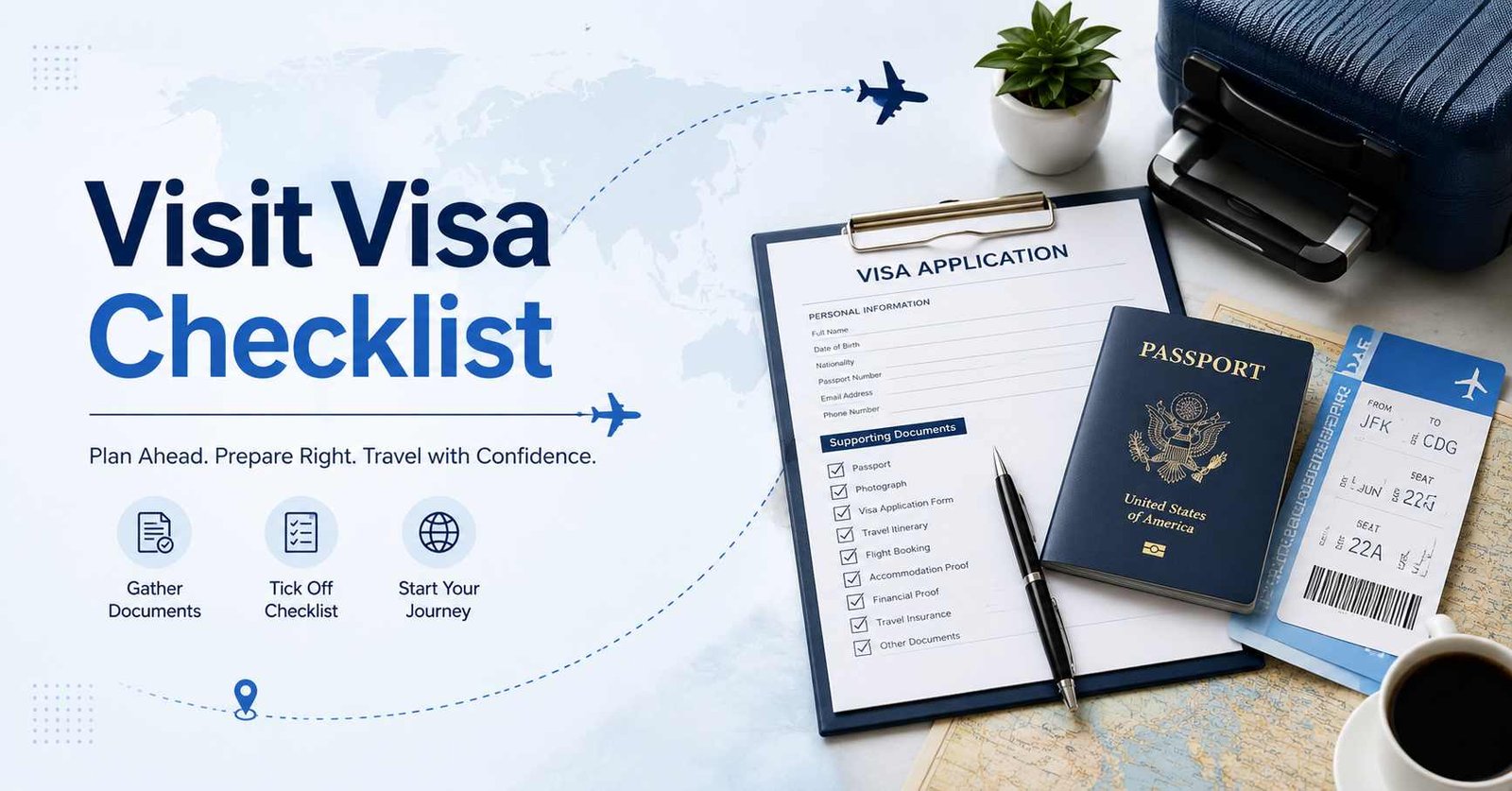
Visit Visa Checklist: Everything You Must Prepare Before Applying
Applying for a visit visa can feel simple, but a small mistake in documents, forms, or financial proof can cause delays or refusal. A visit visa is usually issued for short-term travel, such as tourism, visiting family or friends, attending meetings, medical visits, or short personal trips.
Before applying, understand that every country has its own visa rules. Some require detailed financial proof, others focus on travel history, and some need invitation letters, travel insurance, or confirmed accommodation details.
This visa checklist will help you prepare your documents properly before submitting your application.
What Is a Visit Visa?
A visit visa is a temporary visa that allows a person to enter another country for a limited period. It is mainly used for tourism, family visits, business meetings, events, medical treatment, or other short-term purposes.
A visit visa usually does not allow work, permanent settlement, or staying beyond the approved period. The applicant must prove a genuine reason to travel, sufficient funds for the trip, and a strong reason to return home.
Why a Visit Visa Checklist Is Important
Many visa refusals occur due to incomplete documents, insufficient financial proof, unclear travel purpose, or mismatched application information. A proper checklist helps avoid these mistakes and improves your chances of a strong application.
Before applying, ensure your documents are complete, up to date, genuine, and match the information in your visa form.
Complete Visit Visa Document Checklist
| Valid Passport | Your passport is the main travel identity document. | Make sure it is valid for the required period and has blank pages. |
| Visa Application Form | This is the official form required by the embassy or immigration authority. | Fill in every detail carefully and avoid spelling mistakes. |
| Passport-Size Photos | Required for identity verification. | Follow the exact photo size, background, and format required by the country. |
| Cover Letter | Explains your travel purpose, dates, funding, and return plan. | Keep it clear, honest, and professional. |
| Travel Itinerary | Shows your planned travel dates and places you want to visit. | Avoid fake bookings or unrealistic travel plans. |
| Flight Booking / Reservation | Shows intended entry and exit dates. | Some countries accept reservations instead of fully paid tickets. |
| Hotel Booking / Accommodation Proof | Confirms where you will stay during your visit. | If staying with family or friends, provide host details. |
| Invitation Letter | Required if visiting relatives, friends, or business contacts. | Include host name, address, contact details, and relationship. |
| Bank Statements | Shows that you can afford your trip. | Submit recent statements as per visa requirements. |
| Income Proof | Helps prove financial stability. | Salary slips, ITR, business income proof, or other valid income documents can help. |
| Employment Proof | Shows your current job and reason to return. | Include NOC, leave letter, salary slips, and employment letter if applicable. |
| Business Documents | Required for business owners or self-employed applicants. | Include registration proof, GST details, tax returns, or company bank statements if needed. |
| Student Documents | Required for students applying for a visit visa. | Include student ID, bonafide letter, leave approval, and sponsor documents if applicable. |
| Sponsor Documents | Needed if someone else is paying for your trip. | Include sponsor letter, ID proof, bank statements, and relationship proof. |
| Family Ties Proof | Helps show your connection to your home country. | Marriage certificate, children’s documents, property papers, or dependent proof may help. |
| Travel Insurance | Required by some countries. | Check if insurance is mandatory for your destination. |
| Previous Travel History | Shows your past international travel record. | Attach old visas and entry/exit stamps if required. |
| Visa Fee Receipt | Proof that you paid the visa application fee. | Keep both digital and printed copies. |
| Appointment Confirmation | Required for biometric or visa center submission. | Carry the appointment letter on the submission day. |
| Additional Country-Specific Documents | Some countries ask for extra documents. | Always check the latest official embassy checklist before applying. |
Financial Documents Checklist
Financial proof is one of the most important parts of a visit visa application. The visa officer wants to see that you can afford your travel expenses without working illegally or becoming dependent in the destination country.
Common financial documents include:
- Recent bank statements
- Salary slips
- Income tax returns
- Employment letter
- Business income proof
- Fixed deposit proof, if applicable
- Sponsor’s financial documents, if sponsored
- Property or investment documents, if relevant
Your financial documents should appear genuine and stable. Sudden large deposits without explanation raise doubts. If there is a large transaction, explain it clearly with supporting proof.
Employment and Leave Documents
If employed, prepare documents proving your current job and intention to return after the trip.
Important employment documents may include:
- Employment confirmation letter
- No Objection Certificate from the employer
- Approved leave letter
- Last 3 to 6 months’ salary slips
- Office ID card copy, if required
A strong employment profile helps show you have a reason to return home.
Documents for Self-Employed Applicants
If you are a business owner or freelancer, you may need to show proof of your business and income.
Useful documents include:
- Business registration certificate
- GST certificate, if applicable
- Company bank statement
- Income tax returns
- Client invoices or contracts
- Business profile or website details
- Professional license, if applicable
Self-employed applicants should clearly explain their work, income source, and who will manage the business during their trip.
Documents for Sponsored Visit Visa
If your trip is sponsored by a family member, friend, or company, you must provide sponsor-related documents.
Common sponsor documents include:
| Sponsor Document | Purpose |
| Sponsorship Letter | Confirms that the sponsor will support your trip. |
| Sponsor ID / Passport Copy | Proves the sponsor’s identity. |
| Sponsor Bank Statement | Shows financial ability to support you. |
| Relationship Proof | Shows your connection with the sponsor. |
| Address Proof | Confirms where the sponsor lives. |
| Invitation Letter | Explains why you are visiting the sponsor. |
A sponsor can support your application, but you should still show your own personal, family, financial, or employment ties to your home country.
Travel Purpose Documents
Your travel purpose must be clear and believable. The documents will depend on why you are travelling.
| Travel Purpose | Supporting Documents |
| Tourism | Itinerary, hotel booking, travel plan, financial proof |
| Family Visit | Invitation letter, relationship proof, host documents |
| Business Visit | Business invitation, meeting letter, company documents |
| Medical Visit | Hospital letter, medical reports, treatment estimate |
| Event Visit | Event invitation, registration proof, tickets if required |
| Short Course / Training | Course confirmation, fee receipt, institute letter |
Your application should clearly answer three questions: why you are travelling, who will pay for the trip, and why you will return on time.
Common Visit Visa Mistakes to Avoid
Avoid these mistakes before applying:
- Submitting incomplete documents
- Giving false or mismatched information
- Showing weak or unclear financial proof
- Applying with a passport that is close to expiry
- Not explaining the purpose of the travel properly.
- Providing fake hotel or flight bookings
- Ignoring previous visa refusals
- Not showing strong home-country ties.
- Submitting old or outdated bank statements
- Applying without checking the latest embassy checklist
Honesty is very important in any visa application. Fake documents or false information can lead to refusal and may also affect future visa applications.
Final Checklist Before Submitting Your Visit Visa Application
Before submitting your visit visa file, check the following:
| Final Check | Status |
| Passport is valid and has blank pages | ☐ |
| Visa form is completed correctly | ☐ |
| Name, date of birth, and passport number match all documents | ☐ |
| Travel purpose is clear | ☐ |
| Bank statements are recent and genuine | ☐ |
| Employment or business proof is attached | ☐ |
| Accommodation proof is ready | ☐ |
| The invitation letter is attached if applicable | ☐ |
| Sponsor documents are attached, if applicable | ☐ |
| Travel insurance is arranged, if required | ☐ |
| Visa fee receipt is available | ☐ |
| Appointment confirmation is printed | ☐ |
| All documents are arranged in order | ☐ |
FAQs About the Visit Visa Checklist
1. What documents are required for a visit visa?
Common documents include a valid passport, a visa application form, photos, proof of funds, a travel itinerary, proof of accommodation, employment or business documents, and an invitation letter, if applicable.
2. Is a bank statement required for a visit visa?
Yes, most countries ask for bank statements to check whether the applicant can afford the trip. The required number of months may vary by country.
3. How much bank balance is required for a visit visa?
There is no fixed amount for every country. It depends on your destination, trip duration, accommodation, travel plan, and personal situation.
4. Can I apply for a visit visa without travel history?
Yes, you can apply without a travel history. However, your application should be strong in other areas, such as financial proof, employment, family ties, and a clear purpose for travel.
5. Do I need confirmed flight tickets before applying?
Some countries ask for flight reservations, while others do not recommend buying tickets before visa approval. Always check the official requirements before booking.
6. Is travel insurance mandatory for a visit visa?
Travel insurance is mandatory for some countries and optional for others. For certain destinations, insurance is an important part of the visa checklist.
7. What is an invitation letter for a visit visa?
An invitation letter is a document from a host living in the destination country. It explains why you are visiting, where you will stay, and your relationship with the host.
8. Can a relative sponsor my visit visa?
Yes, a relative can sponsor your visit if the country allows sponsorship. The sponsor may need to provide financial documents, ID proof, address proof, and an invitation letter.
9. What is the most common reason for a visa refusal?
Common reasons include weak financial proof, unclear travel purpose, incomplete documents, lack of home-country ties, false information, or doubts about returning after the visit.
10. Can I work on a visit visa?
No, a visit visa usually does not allow employment. Working on a visit visa can create serious immigration problems.
11. Should I mention previous visa refusals?
Yes, if the application asks about previous refusals, you must mention them honestly. Hiding a refusal can negatively affect your application.
12. How can I improve my chances of a visit visa approval?
Prepare complete documents, provide genuine financial proof, clearly explain your travel purpose, demonstrate strong ties to your home country, and follow the latest official checklist for the destination country.
You can publish this as a general blog, but before posting for a specific country like the USA, the UK, Canada, Australia, or the Schengen area, add that country’s latest official checklist and visa fee details.
Conclusion
A visit visa application is not only about submitting documents. It is about proving that your travel purpose is genuine, your finances are clear, and you have strong reasons to return to your home country after your visit.
Before applying, prepare your checklist carefully, review every document, and follow the latest official requirements of the country you are visiting. A complete and well-organised application can make the visa process smoother and more professional.