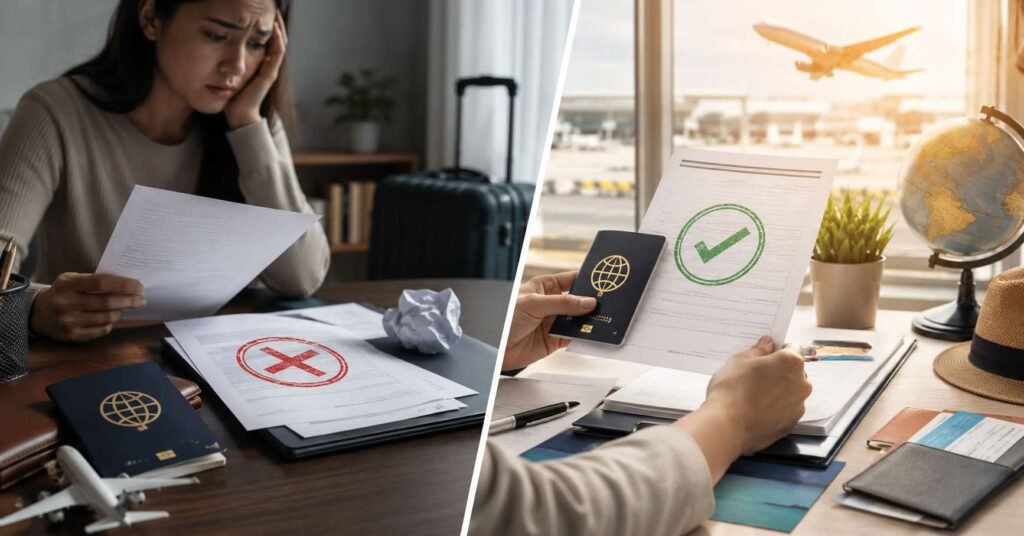
Applying for a visit visa can be exciting, but refusal can be stressful and confusing. Many applicants think having a passport, bank balance, invitation letter, or travel plan is enough for approval. However, visa decisions consider the applicant’s complete profile, travel purpose, financial stability, home-country ties, previous travel history, and document credibility.
A visa rejection does not always mean you can never travel to that country. Often, applicants can reapply successfully after understanding the reason for the refusal and addressing weaknesses. The key is not to resubmit the same file but to prepare a stronger, more convincing application.
This guide explains the most common reasons for visa rejections, how to avoid them, and how to reapply successfully after a refusal.
What Is a Visit Visa Rejection?
A visa rejection means the visa officer was not satisfied that the applicant met the requirements for a temporary visit. The officer may doubt the purpose of travel, financial means, intention to return home, the authenticity of documents, or the overall credibility of the application.
Visit visa refusals are common in countries such as the USA, the UK, Canada, Australia, the Schengen area, and other popular destinations. The exact reason for refusal depends on the country, visa category, and individual case.
Common Visit Visa Rejection Reasons
| Unclear purpose of visit | The officer is not convinced why you are travelling | Provide a clear travel plan, invitation letter, hotel booking, event details, or tourism itinerary |
| Weak home-country ties | The officer doubts whether you will return after your visit | Add employment proof, business documents, family ties, property papers, education proof, or other commitments |
| Insufficient funds | Your bank balance does not look like enough for the trip | Show stable income, proper savings, salary slips, tax records, and realistic trip expenses |
| Sudden large bank deposits | Funds appear borrowed or temporary | Explain the source of funds with evidence such as a sale deed, a bonus letter, business income, or a gift deed |
| Incomplete documents | Important papers are missing or unclear | Submit a complete checklist with updated and readable documents |
| Incorrect information | Details in the form and documents do not match | Carefully verify names, dates, travel history, employment details, and passport information |
| Weak employment or business proof | Officer is not satisfied with your professional stability | Add job letter, leave approval, salary slips, company ID, business registration, GST/tax proof, or client invoices |
| Poor travel history | No previous international travel or past refusal creates concern | Explain your travel purpose clearly and provide stronger financial and home-tie evidence |
| Previous overstay or visa violation | Past immigration record affects trust | Give an honest explanation and proof of compliance after the incident |
| Sponsor documents are weak | Sponsor’s financial or legal status is not properly proven | Add sponsor ID, legal status, bank statements, employment proof, relationship proof, and invitation letter |
| Fake or misleading documents | Any false document can lead to serious refusal or future ban | Never submit fake documents; provide genuine records only |
| Wrong visa category | You applied under the wrong purpose | Choose the correct visa type based on tourism, family visit, business visit, medical visit, or transit |
1. Unclear Purpose of Visit
A common reason for visa rejection is an unclear travel purpose. If your application does not clearly explain why you are visiting, where you will stay, what you will do, and when you will return, the officer may refuse the visa.
For example, simply saying “tourism” may not be enough. A stronger application should include a day-by-day travel plan, hotel bookings, a return plan, and details of places you intend to visit. If visiting family or friends, your invitation letter should clearly state the relationship, the address, the duration of your stay, and the reason for your visit.
2. Insufficient Financial Proof
A visit visa applicant must show they can afford the trip without working illegally or depending on public funds. If your bank balance is low, inconsistent, or unsupported by income proof, your application may be rejected.
A strong financial file may include:
- Bank statements for the required period
- Salary slips
- Income tax returns
- Business income proof
- Fixed deposits or savings proof
- Sponsor financial documents, if applicable
The required amount depends on the destination, trip duration, accommodation plan, and number of travellers. The balance should look natural and match your income level.
3. Weak Home-Country Ties
Visit visas are temporary visas. The officer must be satisfied that you will return to your home country after your trip. If you cannot prove strong ties, your visa may be refused.
Strong home-country ties may include:
- Stable job
- Running business
- Family responsibilities
- Property ownership
- Ongoing education
- Financial assets
- Social and professional commitments
A person with no job, business, regular income, or clear family responsibilities may face a higher risk of refusal unless supported by strong evidence.
4. Incomplete or Poorly Arranged Documents
Sometimes applicants have genuine profiles but are rejected because their documents are poorly organised. Missing papers, unclear scans, expired documents, wrong formats, or unexplained gaps can create doubts.
Before applying or reapplying, prepare a checklist of documents. Every document should support your purpose for travel, financial capacity, and intention to return.
5. Inconsistent Information in the Application
Small mistakes can cause big problems in visa applications. If your form says one thing and your documents show another, the officer may question your credibility.
Common inconsistencies include:
- Different employment dates
- Wrong travel dates
- Mismatch in salary and bank credits
- Incorrect family information
- Missing previous refusal details
- Wrong passport or visa history
- Different spellings of the name
Review your application carefully before submission.
6. Sudden Large Deposits in Bank Account
Many applicants deposit a large amount just before applying. This can raise suspicion because the officer may think the money was borrowed temporarily to show a balance.
If there is a large deposit, explain its source clearly. For example, if the amount came from a property sale, a business payment, a bonus, a savings transfer, or a family gift, provide supporting documents.
7. Weak Sponsor Support
If someone sponsors your trip, the sponsor’s documents must be complete and credible. A simple invitation letter is usually not enough. The sponsor should provide legal status, proof of address, financial ability, proof of employment or business, and proof of relationship with you.
However, sponsorship does not guarantee approval. The applicant must still prove a genuine purpose for travel and an intention to return.
8. Previous Visa Refusal
A previous visa rejection does not automatically mean your next application will be rejected. However, it must be handled carefully. Do not hide previous refusals. Most visa forms ask about past refusals, and giving false information can damage your credibility.
When reapplying, mention the previous refusal honestly and explain how you have addressed the concerns.
9. Past Overstay or Immigration Violation
If you overstayed in any country, worked without permission, violated visa conditions, or were deported, your future visa applications may be affected. In such cases, honesty is very important.
Provide a clear explanation, supporting documents, and evidence that you now understand and respect visa rules.
10. Fake Documents or Misrepresentation
Submitting fake bank statements, false employment letters, edited documents, or incorrect information can lead to serious consequences. It may result in refusal, visa ban, cancellation, or future immigration problems.
Always submit genuine documents. If your profile is weak, improve it honestly rather than use fake papers.
How to Reapply Successfully After a Visit Visa Rejection
Reapplying after rejection requires proper planning. Do not rush or submit the same documents again. First, understand why the visa was refused, then prepare a stronger file.
Step 1: Read the Refusal Letter Carefully
Your refusal letter is the most important document after rejection. It may mention concerns about funds, travel purpose, home ties, documents, or credibility. Read every point carefully and prepare your new application accordingly.
Step 2: Identify the Weak Areas
List all possible weaknesses in your previous application. For example:
- Was your travel purpose unclear?
- Was your bank balance low?
- Were there sudden deposits?
- Was your employment proof weak?
- Did you miss any documents?
- Did your sponsor provide incomplete details?
- Did you fail to explain the previous travel history?
If you reapply with the same information and documents, the result may be the same. A successful reapplication should clearly show what has changed or what new evidence you provide.
If you reapply with the same information and documents, the result may remain the same. A successful reapplication should clearly show what has changed or what new evidence you are providing.
Step 4: Prepare a Strong Cover Letter
A cover letter explains your case clearly and professionally. It should include:
- Your purpose of visit
- Travel dates and duration
- Who will pay for the trip?
- Employment or business details
- Family and financial ties in your home country
- Previous refusal explanation
- Documents attached to the application.
Keep the cover letter honest, simple, and evidence-based.
Step 5: Strengthen Financial Documents
Your financial proof should match your travel plan. If the trip is expensive and your income is low, the officer may doubt your ability to afford it.
Add proper financial documents such as:
- Salary slips
- Bank statements
- Income tax returns
- Business income proof
- Savings proof
- Fixed deposits
- Sponsor documents, if applicable
Avoid large unexplained deposits.
Step 6: Prove Strong Return Intention
Since visit visas are temporary, your application should clearly show why you will return. You may submit:
- Employer leave approval
- Job confirmation letter
- Business ownership documents
- Family responsibility proof
- Property documents
- School or college enrollment proof
- Ongoing work contracts
Step 7: Improve Travel Plan
A vague travel plan can weaken your application. Provide a realistic itinerary based on your budget and trip duration. Your accommodation, flight plan, invitation, and activities should match.
Step 8: Be Honest About Previous Refusals
Never hide a previous rejection. If the form asks about past refusals, mention them honestly. Hiding a refusal can create a bigger problem than the refusal itself.
Step 9: Check Country-Specific Requirements
Every country has different visa rules. A UK visitor visa, a Canadian visitor visa, a US B1/B2 visa, an Australian visitor visa, and a Schengen visa may have different document requirements and decision-making processes.
Check the latest official requirements before applying.
Step 10: Apply When Your Profile Is Stronger
Sometimes it is better to wait and improve your profile before reapplying. For example, if refused due to weak finances or employment instability, wait until you can show higher income, better savings, or improved documents.
Visit Visa Reapplication Checklist
| Document / Evidence | Why It Is Important |
| Refusal letter | Helps identify the exact reason for rejection |
| Updated application form | Ensures correct and fresh information |
| Valid passport | Basic identity and travel document |
| Cover letter | Explains your purpose, profile, and reapplication reason |
| Travel itinerary | Shows a clear travel plan |
| Hotel booking or invitation letter | Supports your stay arrangement |
| Employment letter or business proof | Shows professional stability |
| Leave approval letter | Proves you are expected to return to work |
| Bank statements | Shows financial ability |
| Income tax returns | Supports income credibility |
| Salary slips or business income proof | Shows regular earnings |
| Property or asset documents | Supports home-country ties |
| Family documents | Shows family responsibilities |
| Sponsor letter and sponsor financial proof | Required if someone is funding your trip |
| Previous travel history | Shows past compliance with visa rules |
| Explanation for previous refusal | Shows that you addressed the earlier concerns |
Mistakes to Avoid When Reapplying
- Reapplying immediately without improving your file
- Ignoring the refusal letter
- Submitting the same documents again
- Adding fake or edited documents
- Showing borrowed money without explanation
- Hiding previous visa refusals
- Giving unclear travel dates
- Providing weak sponsor documents
- Writing a long, emotional letter without evidence
- Applying under the wrong visa category
Can a Visit Visa Be Approved After Rejection?
Yes, a visit visa can be approved after a rejection if the new application properly addresses the reasons for the previous refusal. Many applicants get approval after improving their documents, explaining financial sources, showing stronger home ties, and submitting a clearer travel plan.
However, approval is never guaranteed. Visa decisions depend on the applicant’s individual profile and the destination country’s rules.
Frequently Asked Questions
1. Can I reapply after a visa rejection?
Yes, in most cases, you can reapply after a visa rejection. However, you should first understand the reason for the refusal and improve your application before resubmitting.
2. Should I reapply immediately after rejection?
It depends on the reason for refusal. If the rejection was due to missing documents or a minor mistake, you may reapply after correcting the issue. If the issue was weak finances, unclear purpose, or weak home ties, it may be better to wait and strengthen your profile.
3. Will a previous visa rejection affect my next application?
Yes, a previous rejection can affect your next application, especially if the same concerns are not addressed. However, if you explain the refusal honestly and submit stronger evidence, approval is still possible.
4. Can I hide my previous visa refusal?
No. You should never hide a previous visa refusal. Most countries ask about past refusals in the application form. Giving false information can lead to serious consequences.
5. Does having a sponsor guarantee a visit visa approval?
No. A sponsor can support your application, but approval depends on your complete profile. You still need to prove a genuine travel purpose, financial credibility, and intention to return home.
6. How much bank balance is required for a visit visa?
There is no fixed amount for every case. The required balance depends on the destination country, trip duration, accommodation, travel plan, and number of applicants. Your funds should be realistic and supported by regular income.
7. Can I apply again with a new passport after rejection?
Changing your passport does not remove your visa history. You should not try to hide previous refusals. Instead, address the reasons for the refusal properly in your new application.
8. Is a cover letter important for a visit visa reapplication?
Yes, a cover letter can be very helpful. It explains your purpose of travel, financial situation, home ties, and how you have addressed the previous refusal.
9. Can travel history improve my visit visa chances?
A good travel history can support your application because it shows that you followed visa rules in the past. However, travel history alone does not guarantee approval.
10. What is the biggest reason for a visa rejection?
The most common reasons include unclear travel purpose, insufficient funds, weak home-country ties, incomplete documents, inconsistent information, and doubts about the applicant’s intention to return.
11. Can fake documents cause a visa ban?
Yes. Fake, edited, or misleading documents can lead to refusal, future restrictions, visa bans, or legal consequences. Always submit genuine documents.
12. Do I need professional help after a visit visa rejection?
Professional guidance can help you understand the reason for the refusal and prepare a stronger file, but it does not guarantee approval. The most important thing is to submit genuine, complete, and well-explained documents.
Final Thoughts
A visa rejection can be disappointing, but it is not the end of your travel plan. The most important step is to understand why the application was refused. Once you know the reason, you can prepare a stronger, more complete application.
Do not rush reapplication. Focus on genuine documents, clear travel purpose, stable finances, strong home-country ties, and honest explanations. A well-prepared reapplication can improve your chances of success.
Related Guides
- Can You Work on a Visit Visa? Everything You Need to Know
- Visit Visa Checklist: Everything You Must Prepare Before Applying
- Visit Visa vs Tourist Visa: What’s the Difference & Which One Should You Apply For?
Looking for a job abroad? Browse the latest Gulf jobs on Daily Visas – new vacancies every hour – or try our free visa tools.
[…] Gathering the right documents is the most critical step. Missing even one item can lead to rejection. […]
[…] 1: The US F-1 student visa has a refusal rate of around 35% for applicants from certain countries, making financial and intent documentation […]